
Pharmacy benefit management wasn't invented to be complicated.
The original premise was simple: as employer-sponsored health insurance expanded in the mid-twentieth century, someone needed to manage the logistics of prescription drug coverage. Process the claims. Negotiate with pharmacies. Help employers offer a benefit their workforce could actually use. The pharmacy benefit manager was built to reduce administrative burden and lower costs while acting as a neutral intermediary between pharmacies, drug manufacturers, and plan sponsors.
That was the intent. Somewhere along the way, it got lost. A PBM works in your best interest only when incentives, clinical decisions, and pricing are aligned.
The PBM model Is broken: What the FTC investigation revealed
In January 2025, the Federal Trade Commission (FTC) released findings on a multi-year investigation into PBM pricing practices. The findings put a price tag on that drift: billions in revenue generated from spread-pricing arrangements that left plan sponsors paying significantly more than pharmacies received for the exact same medications.
The FTC found manufacturer rebates can also create misaligned incentives. This happens when PBMs favor higher-list-price drugs because they generate larger rebates. When PBMs favor drugs based on financial incentives, they can drive formulary decisions that don’t necessarily minimize total cost for plan sponsors or patients
The investigation is a signal that the industry has not consistently worked in the best interest of the employers and employees it was designed to serve. So what does "working in the best interest" actually look like in practice? That's what we're here to explore.
How do you know if your PBM is working for you?
Not all PBMs work the same. Pharmacy benefit management works when the patient comes first. It works when the employer's goals—healthier people and sustainable costs—are the same goals the benefit partner is working toward. Aligned incentives aren’t a nice-to-have. They should be the foundation of the relationship.
When evaluating whether a PBM is working in your best interests, ask these three questions:
Why PBM accountability matters for employers and patients
Are my employees getting healthier?
Pharmacy benefit management has historically been built around transaction volume — processing claims, managing formularies, and administering prior authorizations. That foundation served a purpose. But as the science evolved and the opportunity to intervene earlier became clearer, the model has been slow to follow.
The conditions driving the highest cost for employers—obesity, diabetes, cardiovascular disease—are better understood and more treatable today than at any point in history. Early clinical intervention works. The right medications, combined with lifestyle support, produce meaningfully better outcomes and lower long-term costs. The tools to deliver real value to patients and employers exist.
A PBM that profits from volume has little financial reason to reduce the number of prescriptions a patient takes, consolidate redundant medications, or invest in clinical interventions that might eliminate the need for a drug altogether.
Ask whether your PBM is actually leveraging advanced clinical expertise to reduce the number of prescriptions instead of increasing them.
Are formulary decisions driven by clinical evidence?
One of the most important question employers can ask is whether formulary decisions are made on clinical merit rather than financial incentives.
And, do clinical decisions focus on total cost of care (health care cost plus pharmacy cost), not just per-claim cost? For example, a per-claim cost may be lower, but if it is not the most effective treatment, the total cost of care may be higher. The answer should always be yes — and if your PBM can't give you a clear, confident answer, that tells you something important.
Pharmacist-led PBMs operating outside the constraints of venture capital funding and public profit reporting may be best positioned to prioritize clinically sound, evidence-based decision-making. To understand how this translates to real patient impact, it helps to explore the pharmacist-led PBM model and patient outcomes in greater depth.
Can your PBM prove its transparency claims?
Nearly every PBM claims to be transparent. But true transparency means something specific: a clear accounting of all fees, pricing with reasonable and fair pharmacy reimbursement, rebates that are passed through to the employer, and no hidden spread between what plan sponsors pay and what pharmacies receive. Transparency isn't a marketing message — it's a verifiable standard.
If your PBM can’t answer these clearly, you’re not getting stewardship; you’re getting administration. From the start, these transparency ideals are what we built True Rx around.
How True Rx puts patient-first PBM principles into practice
At True Rx, we call ourselves Health Strategists because that's what this work actually requires: proactive, clinically grounded partners acting in the best interest of clients and patients with every decision. Instead of driving up prescription volume, our clinical programs focus on things like ‘food as medicine’ and smart lifestyle choices that are sustainable and lower overall cost of care. We move toward clinical evidence, not away from it, and we invest in interventions that produce better outcomes.
We look for innovative ways to support health and cost containment. Our recent collaboration with Waltz Health to provide industry-leading direct-to-employer pricing on high cost GLP-1s is an example of this.
Unlike PBMs constrained by venture capital funding or stock market demands, we answer to one priority only: the needs of our clients and patients. Every time.
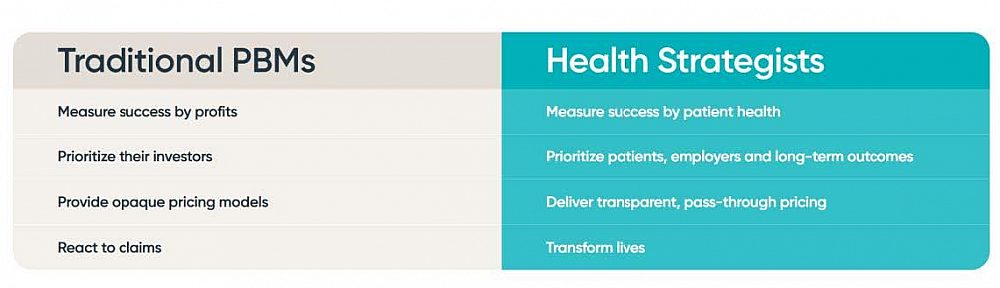
Accountability to Patients Over Profit: The True Rx Standard
In fact, we care as much about the experience as the outcome. Benefits are personal. Employees navigating a diagnosis, managing a chronic condition, or trying to afford a specialty medication deserve to feel that someone is in their corner. We built True Rx to be that partner.
Pharmacy benefit management was designed for a different era. Today's employers deserve a modern approach built around a simpler standard: better outcomes for patients, and full accountability to the people paying for their care.